Wednesday, January 18, 2012

Midwinter in Dallas: Day 1

I've arrived in Dallas and am getting ready for a crazy busy week. One of my more important roles is as a member of the Executive Board and doing liaison visits to a variety of units. Here are some highlights from the talking points that are compiled by ALA Executive Director Keith Michael Fiels.

School Libraries
  • Advocating for school libraries is a top Association priority this year. Between local budget cuts and the anticipated re-authorization of the Elementary and Secondary Education Act (ESEA), the urgency has never been greater.

    President Molly Raphael has appointed a special Task Force on School Libraries, with membership from all the divisions, to lead ALA efforts to strengthen, and preserve school libraries.

    AASL President Carl Harvey has initiated a White House petition on school libraries, which specifically petitions the Obama administration to “ensure that every child in America has access to an effective school library program.” 25,000 signatures are required in order for this petition to reach the President Obama’s desk, no later than February 4, 2012. It is a step towards creating awareness about school libraries, specifically for the need for an amendment for school libraries within the Early and Secondary Education Act (ESEA), due to be reauthorized this year.
E-Content and Libraries
  • Dealing with new digital content is one of the most pressing concerns facing libraries of all types, and is a big part of the transformation referred to in ALA’s strategic plan. A 25 member Digital Content and Libraries Working Group has been appointed by President Molly Raphael. Sari Feldman (Cuyahoga County Public Library) and Robert Wolven (Columbia University) are the co-chairs and President Elect Maureen Sullivan is the Executive Board Liaison. The Working Group began its work online and will meet in-person for the first time during the Midwinter Meeting in Dallas. Preliminary talking points on ebook lending and principles for digital lending were developed in the fall. These will be reviewed and revised by the Working Group.

    Drs. Stanley Besen and Sheila Kirby are developing a white paper for ALA on e-book economic models and licensing. This study will be released in the near future.

    American Libraries established a new blog on e-content issues to provide a mechanism for rapid response. Christopher Harris, a school librarian and member of the Working Group, serves as the editor of this blog. If you have topics you'd like him to write about or want to write about yourself, please let him know.  American Libraries has also created a dedicated section on E-content issues in AL Direct. Materials related to digital content and libraries will be on the Transforming Libraries website, managed by the ALA Library.
 Virtual Membership Meeting 
  • Mark your calendars!  ALA’s second virtual membership meeting will be held on Tuesday, June 5th, from 3-4:30 CST. Last year’s first Virtual Town Hall meeting was a great success, with 528 members participating. Real time member polling allowed participants to select the questions they thought most important for discussion. 
Membership 
  • ALA membership in November 2011 stood at 59,824, slightly lower (-2.69%) than November 2010.  In the organizational member categories, increases were tallied for medium and large libraries and decreases for very small, small, and very large libraries.  On the personal member front, membership increases were seen in the support staff, retired, non-salaried, international, friend, and continuing member categories while declines were noted in the regular, student, and trustee categories.   For the first quarter of the 2012 programmatic year, seven round tables and three divisions had membership increases, while twelve round tables and eight divisions had decreases. 
Midwinter Facts and Highlights
  • Advance registration for Dallas is 4823, compared to 5180 for the 2011 Meeting in San Diego. There are 3269 exhibitor personnel registered, representing 430 exhibiting companies and organizations.

    Over 1200 separately scheduled meetings & events are planned. The number of committee meetings is lower, while the number of discussion group meetings has increased.

    Meeting includes an array of new events, including “Dine Around Dallas,” the Masters Series, the Midwinter Conversation and Think Fit @ ALA (aka, The Fun Run).

    The Midwinter Conversation, led by ALA President Molly Raphael and Dr. R. David Lankes will provide an opportunity to engage with colleagues in open conversation around “Empowering Voices: Transforming Communities”. These two conversations, on Saturday and Sunday afternoon, will use a “world cafĂ©” process.  The conversations will lead into the ALA President’s Program, with Rich Harwood.
Election Year Dos and Don’ts 
  • During an election year, which is defined as beginning January 1 of the year in which the election will be held, ALA and its members must avoid any action that could give the impression that the  Association — rather than you as an individual private citizen — is engaging in “political speech” (“the support of or opposition to a candidate for public office”) or that ALA resources are being used for that purpose.
  • ALA, because of its particular tax exempt status, is expressly, absolutely prohibited by the U.S. Internal Revenue Code from engaging in “political speech.” The consequence is revocation of tax exempt status. There are no “intermediate” or “warning” consequences, and the “zero tolerance” enforcement policy of the IRS has been upheld by the courts.
  • “ALA resources” would include any use of ALA titles (like councilor, chair of…, president of...); ALA discussion lists, blogs or wikis (including those of ALA divisions, round tables and other groups that are part of ALA); stationery; publications or websites; headquarters or conference meeting rooms; or, staff time.
  • “Political speech” includes activities such as soliciting or making campaign contributions, providing a forum for a candidate (in print or at a conference, for instance), expressing “support for or opposition to” a candidate or political party.
  • Political speech” is different from “lobbying,” which seeks to influence legislation or regulation. Even during an election year, ALA continues to lobby for legislation and regulation that will benefit libraries and the public. There are regulations and limitations on lobbying by organizations like ALA, of course — and ALA works within the applicable laws.
  • A number of background documents have been developed to guide ALA leaders and staff through a complex legal environment. Four such documents are available as PDFs: ALA Legal Framework, Election Year Rules, Election Year Rules – Additional Notes, and Lobbying and ALA: Fact Sheet.
Neal-Schuman
  • ALA has acquired Neal-Schuman publishers. Neal-Schuman will become part of ALA publishing, and operations will be moved to Chicago, they will continue to exist as a separate imprint. In reviewing the potential acquisition, ALA conducted extensive due diligence and developed a long term business plan, as well as an independent valuation. The purchase plan involves financing the acquisition through a bank loan, which will be repaid over a period of 5-7 years out of the proceeds from the operation. Under the terms of the agreement, information on the acquisition will be shared by Treasurer Jim Neal (not the Neal in Neal-Schuman) on Monday as part of his report to Council. This information will be available to the membership following his report. We are committed to total transparency, and will be answering any and all questions that are asked. This is a great opportunity for the association that supports our mission and goals.

Tuesday, January 17, 2012

Midwinter Preparations 2012


It's that time again! Tomorrow I'm headed to the ALA Midwinter Meeting in Dallas. As usual, my calendar is pretty full. I'm actually looking forward to all of my meetings in addition to seeing many great colleagues and making new friends.

Highlights from my schedule include:
I'll be doing the introduction for the Special Masters Series: A Library occupies Occupy Wall Street.
I'll talk very briefly (5 minutes!) to the 2012 Emerging Leaders class about getting involved in round tables.
 Attending all meetings of the ALA Executive Board, ALA Council, and the Budget Analysis & Review Committee (BARC).
Liaison visits to a variety of ALA divisions and committees.
And, of course, talking to people in the hallway of the convention center and at social gatherings.

Monday, January 16, 2012

Coming soon: Library Day in the Life 8

I've signed up to participate in the Library Day in the Life Project: Round 8.
The Library Day in the Life Project is a semi-annual event coordinated by Bobbi Newman of Librarian by Day. Twice a year librarians, library staff and library students from all over the globe share a day (or week) in their life through blog posts, photos, video and Twitter updates.
 It's a great way to get to know other library people from around the world and learn something new.

Wednesday, January 11, 2012

Ensure that every child in America has access to an effective school library program

Carl Harvey, 2011-2012 American Association of School Libraries president, has initiated a White House petition on school libraries, which specifically petitions the Obama administration to “ensure that every child in America has access to an effective school library program.” 25,000 signatures are required in order for this petition to be viewed by White House staff, no later than February 4, 2012.

Please take a few seconds to sign this petition, spread the word to your member groups, ask your colleagues and library supporters in your circles to sign on, and spread the word via Facebook, Twitter and other channels!

* We’ve heard that the petition software is temperamental. If you cannot sign in on your  first attempt, please log out and log back in. Or, try a different web browser, or as a last resort, try a different computer.

* White House petitions must be authored by individuals, not any association. Therefore, Carl has introduced this petition as an individual, not as a representative of AASL or ALA.

Thank you,

Marci Merola
Director
Office for Library Advocacy
American Library Association
800.545.2433, x2431
mmerola@ala.org

Friday, December 9, 2011

Power to the Patron: Panel Presentations


Lisa Carlucci, Director of design think do, put together this year's Library Journal Virtual Tech Summit "Power to the Patron". The event included a keynote, three panels, and a tweet-up #ljtechsmt. I was the twitter moderator for the keynote, first panel, and assisted with the tweet-up. This entry is focused on the first panel and the tweet-up.

The first panel, moderated by Cody Hanson, was Mobile Apps: What Do Users Need? 
Nate Hill, Web Librarian doing design and development work at the San Jose Public Library, talked about the Scanjose.org project. Scanjose is a walking tour of San Jose using images from the library collection. It is best experienced when using it on a mobile device or a tablet in San Jose, CA. For this project, Hill had to decide if they wanted to create a native mobile app or just have it work in a web browser. Working in  a browser meant they can could do what they already knew what to do. HTML5 and Drupal 7 were used, and jQuery mobile was also used for easy to use buttons. This project allows the library to engage people in a new way


Rebecca Ranallo, Internet & Media Services Manager for the Cuyahoga County Public Library, talked about CCPL Mobile. The library decided to go moble to support its mission: be most convenient public library. CCPL mobile is partnership with Boopsie. The app was also developed because the current library website is pretty inflexible. A great thing about the CCPL app is it allows you to check out materials via mobile device right there in the stacks. CCPL stopped security stripping materials as they found it was cheaper to replace missing items than security tag everything in their collection. Since implementing the app, they've seen a significant increase in use of digital materials. Approximately 4300 customers (predominately iPhone and Android) are using the app. Popular uses: catalog search, self checkout, digital media, library locator, my account. CCPL advertised the availability of the app via library website and social media: purchased Google ads and created QR codes.


Michael Whitchurch, chair of the Learning Commons Department in the Harold B. Lee Library at Brigham Young, was the next panelist. Whitchurch started by asking participants where they've seen QR codes. Next he ask when should we use QR codes in libraries? What is the Value Add? Value add included things like event details (lecture announcement poster), independence (audio tour, activity that allows for participation flexibility), an actionable task (reserving a room). Where should you put QR codes? Point-of-need, location specific information. Sign positioning is key, near signs with similar information. Why use QR codes? Convenience (quicker), simplify a task, url duplication. Have a purpose beyond "hype" for your QR code, use when and where appropriate for the reason. Whitchurch also suggested visiting the Library Success wiki on QR Codes.


Dan DeSanto, Information and Instruction Services Department at the University of Vermont, was the final panelist. He discussed the Long Trail digital collection. He created an app using USGS Geographic Names Information System (GNIS) headings. GNIS provides standardize latitude/longitude points to create graphical access point. The app is still very much in development. Building/designing using Xcode 4, and  collaborating with the Computer Science department on its development. DeSanto likes working with apps because: extensibility, ability to put multiple collections in one app. He also likes working with apps because libraries create acces to digital collection at "point of interest".

After tweeting this session, I took a break to get away from the computer and eat lunch. I popped back later to catch the end of the final session and participate in  the tweet-up.

For me, one of the true "power to the patron" things mentioned was CCPL no longer using tattle tape in their print materials.

During the tweet-up, one of the best questions I saw asked was posted by Stephanie Chase @acornsandnuts:
For the post-#ljtechsmt crowd: if you could point a non-librarian to one bk/blog/wbste/resource dscr what libraries are about, it would be...
I'd be really interested in what titles you'd suggest.

Overall this was a pretty thought-provoking event. I appreciated the opportunity to interact with others around these topics and services. As always, I learned many new things.

Also check out: LJ Virtual Tech Summit Explores How Libraries Use Tech To Connect with Patrons

Thursday, December 8, 2011

Power to the Patron: Keynote by Bryan Alexander


Lisa Carlucci, Director of design think do, put together this year's Library Journal Virtual Tech Summit "Power to the Patron". The event included a keynote, three panels, and a tweet-up #ljtechsmt. I was the twitter moderator for the keynote, first panel, and assisted with the tweet-up. This entry is focused on the keynote.


The keynote was presented by Bryan Alexander, senior fellow at the National Institute for Technology in Liberal Education, which provides outreach, communities of practice, research. Here are some highlights from Alexander's keynote based on my tweets.
Emerging technologies: thinking about multiple layers that overlay each other, as well as what they expose and reveal. What strata haven't been revealed?

Extrapolation: use it to assess larger fields, rising fields and declining industries.

Environmental scanning: multiple sources, overtime, pattern glimpses. OCLC does a good job of this. Environmental scans are helpful for seeing trends, but be careful to to see things that do not exist. Alexander talked about one of his favorite environmental scans from Kevin Kelly: screening, interacting, sharing, flowing, accessing, generating.

Premise of social media is that we make stuff, and that making stuff keeps going.

Construction of scenarios: creating small narratives about the future. These are not predictive, but allow you to explore ideas.

Futures market: pretend market (a game) in which players buy and sell shares in a future event. These are often applied for example to the stock market, sports (my love of fantasy football!), predicting who will win the U.S. presidency. Alexander ran futures market on how many institutions would participate in Flickr's Creative Commons project by 3/26/09. Whenever you try to predict the future, there are wild cards aka Black Swans.

The Horizon Report: used Delphi process, asked five questions. Time to adoption horizon: one year or less.

Technologies to watch for: ebooks, gaming based, gesture-based computing. We don't talk about social media, it's already taken over. Social media example: blogs being used in education (courses, scholarship), podcasts still huge, wikis for coursework. Social media tools are being used in a variety of mainstream ways. According to Alexander, "It's simply gone wild in education."

Private closed-door spaces are now accessible via social media.

Media permeable classrooms changes the way we teach.

Ebooks: Project Gutenberg goes back to the '70's. Format variation and diversity one of the problems. However, the presence is enormous. We might see new ways of reading and sharing as a result of ebook growing pains.

The ecology of devices: multiple devices competing and reinforcing each other. What do we already use? Laptops, mp3, clickers, cameras, netbooks. Devices are offering us with ways to interact with content, such as smart pens, tablets, etc.

Augmented reality (AR): instead of creating a virtual world, push the virtual into the actual world. Example: Beatles "Abbey Road" experience with smartphone. Role of the gaming world in AR. Alexander discussed games and gaming, mentioning Angry Birds, Farmville, and others. Gaming in libraries.

Gamified reality: games seeping out into everyday life, they are connecting more directly in literal practical conceptual levels. Airlines create gamification experience with levels in rewards programs think of it as a leader board. Gartner Associates felt mouse was on it's way out with touch screen, hand-held, or hands-free (video capture) operation/interaction are coming in.

1. Storytelling. 2. Critical literacy. 3. Going around the web. Storytelling in social media. Digital storytelling allows you to remix content. Storytelling example uses 5 Flickr images (examples from groups here). Only text is the title. The pictures tell the story. Alexander mentions We are the 99% tumblr as an example of digital storytelling.

Information literacy is needed more than ever. Alexander cited Ann Blair's Too much to know. The problem isn't abundance, we haven't developed good lenses. - Clay Shirky. Alexander feels librarians are heroes in this (information literacy).

Alexander read an except from Long Live the Web and encouraged attendees to read the entire piece.
From the Q & A:
Alexander noted librarians have wonderful voices to advocate for standards. He is a self-confessed "librarian fanboy".

What should librarians be aware of with regards to privacy in libraries? Users are very happy to share their private lives, sometimes we even pay for the privilege. Library world has critical role in advocating for patron's right to read and consume media on their own.

There is a huge recognition that we need more information literacy. Libraries may need to to make more opportunistic alliances.

Reframing and rethinking = what libraries can do to help with the importance and existence of digital storytelling.

People's love of diversions = different devices. This goes back to the discussion of the ecology of devices. More is better. Libraries when planning for technology should keep in mind that diversion devices could be made available.

A question was asked about archiving the digital world. Alexander noted the Library of Congress tweet archive and internet archive are good, but how do we capture someone's Farmville progress? Emulation can be another good way to archive. Actual physical archives still have a role to play in this process.

Gaming in libraries: thematic, casual games (think tetris, mindsweeper). Alexander suggested Jay is Games for additional ideas.
 You can follow Alexander on twitter: @bryanalexander

Saturday, November 12, 2011

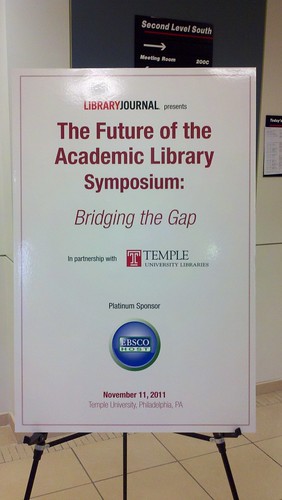
Academic Library Symposium: Bridging the Gaps

I attended the LJ/Temple Academic Library Symposium in Philadelphia. The theme was "Bridging the Gaps". The keynote and panels for the day were great opportunities to identify, acknowledge, and begin exploring ways to close those gaps. Several attendees tweeted from the event using the hashtag #futurelib11.

The morning started with a keynote by Kristin Antelman from North Carolina State University. She talked about some of the cultural gaps in academic libraries. One of th gaps is everybody vs IT. Angelman argued communication style and differences in decision making are major components of this gap. She also mentioned everybody vs administration is another gap, "citing some of the controversy over the Taiga forum statements as an example of library culture clashes" (tweeted by @hadro). Antelman noted the commonalities of these gaps are the preconceptions, and when she added trust as a major contributor it strengthened that concept for me.

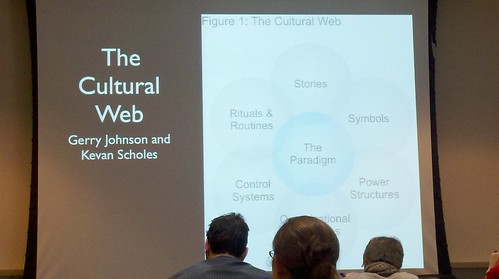
Cultural web slide


Antelman spent a good amount of time on the Competing Values Framework and how it can aid in revealing gaps with an eye towards bridging them. One of my favorite quotes was "Organizational culture should never be viewed as static." I think that this is often a contributing factor to culture gaps in academic libraries. Strategies for bridging these gaps include assessing them as an organization and setting goals around actionable specifics. Antelman asked "Can there be a shared vision if there isn't a shared understanding of the culture?" I don't think I was the only person in the room who had an "a-ha" moment when she asked that question. She closed the keynote by showing the video "What are our future library leaders thinking?"


Immediately following her keynote, Antelman facilitated the first panel of the day "Innovation: Freedom vs Control". Laurie Allen (Haverford College), Damon Jaggars (Columbia University), Bill Mayer (American University), and Jessica Rossi (Community College of Philadelphia) introduced themselves and told us why they were invited to be part of this panel. The majority of the time was spent answering questions from the audience. Those questions included:
  • How do we keep communication flowing in both directions despite the organizational layers?
  • How do you leverage individual effort and excellence for institutional benefit?
  • What do we do about the idea that libraries are just books? Is it the administration's job to correct this misconception?

Antelman facilitating Q&A for Innovation: Freedom vs Control
Kristin Antelman facilitating the first panel.


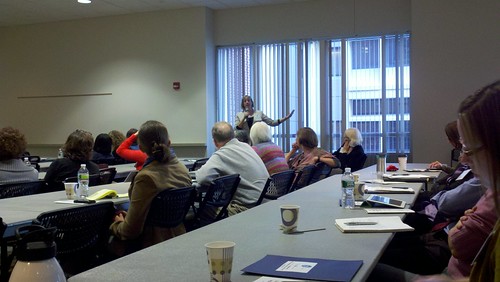
I facilitated the second panel "People: Strengthening the Culture". I gave a very brief introduction:

This segment is a conversation focused on the people in and related to academic libraries. My colleagues who make up today's panel each bring a difference voice to our discussion. They will speak frankly about this pivotal gap in our culture.
Valeda Dent, Erin Dorney, Andy Burkhart, and Diane Skorina responded to the questions I wrote to frame the discussion.

  1. What are the major misunderstandings in academic libraries? How do those misunderstandings manifest?
  2. We've cited a number of "diversities of workforce" (generational, experience, students, status, user needs, etc.) and their associated misunderstandings that make academic libraries look very different, particularly moving forward.

    • How do we deal with resistance to current and future changes?

    • How does that resistance impact our library missions? College/university missions?

    • What effect does all this have on our ability to both recruit and retain the very best?

  3. In 30 seconds or less what is the most important gap to bridge and why?
I left time for questions from the audience. The questions and comments were very good and helped to expand the conversation. An audience member noted that in many academic libraries a large percentage (65% was cited for the speaker's library) of employees are support staff, but most of the responses were focused on librarians. One audience member noted that a gap related to ethnic and racial diversity of academic librarians was something the panel did not directly address. Challenges related to mentoring, retention, and having more frank and direct conversations about this topic were also identified.


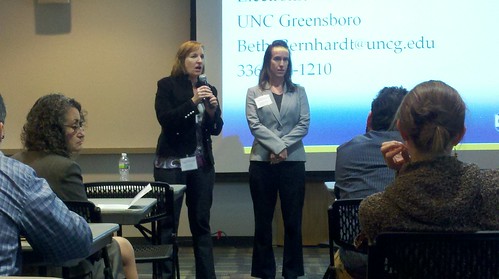
Jody Condit-Fagan and Beth Bernhardt highlighted their experiences with the "Discovery Services Ignite Staff Collaboration and Empower End Users" session.

Discovery Services panel
Beth and Jody answer questions.


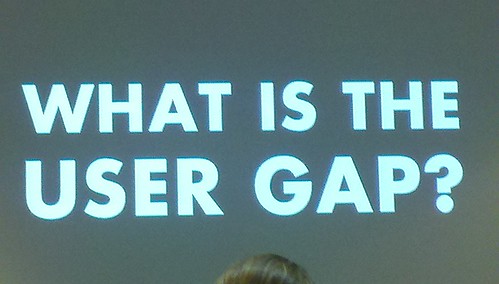
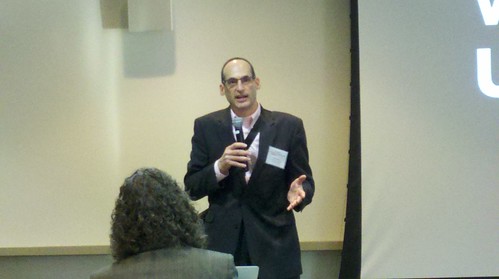
After lunch, Aaron Schmidt and Amanda Etches-Johnson, principals at Influx Library User Experience Consulting, introduced the afternoon session on the User Experience. It was noted to close the user gap, need to know what to change and have the ability to change it. To know more about people, we need to study them. Focus groups and surveys are better for learning people's opinions. Contextual inquiry as a great way to see how people are using the library. Schmidt ended with the useful reminder that "user research is cyclical."

Do you know?


Schmidt and Etches-Johnson asked a group of Temple students (three undergraduates, one graduate) a series of questions about their experiences using the campus library as well as electronic resources. The process was then repeated with four faculty (three from Temple, one from Drexel). Here are my observations based on my session tweets.

Students:

  • students use the library to check out books, especially textbooks that are "overpriced", to do high volume printing, and find a quiet space to study away from their apartments. It is also a place to get help, Internet access, synergy of research process tools.I found it particularly interesting that quiet space was cited as a motivator to use the library.
  •  One student wished the library were prettier and there were more libraries on campus so she could "library hop" to get a change of scenery. 
  • Students wished there were more outlets, better seating arrangements and seating options, better lighting in the library. 
  • Students did not use library when they were hungry or when they wanted to socialize and work. Certain coursework was cited as being okay to complete when hanging out with friends.
  • 1 out of 4 students had a digital textbook required for class. Two of the three indicated they preferred print textbooks.
  • An undergrad just said he "doesn't really know what the qualifications to be a librarian are."
  • Despite not really using the library or librarians, student felt it would be a negative to the campus if the library closed.
  • Undergrad indicates there could be a circulation based determination (no circ for 2yrs) for converting a book to e-copy.
Faculty:
  • Most panelists using library in role of teacher as opposed to for their own scholarship.
  • Faculty want students to use the print, browse shelves. 
  • Panelists use their librarian for course related instruction. One faculty member said "Using experts is part of research process."
  • One faculty member allows multimedia assignments, but most students choose to write a paper. 
  • One faculty member noted "digital literacy is a limited literacy".
  • Students need to experience primary source research in archives.  
  • Faculty asked how they think undergrads can evaluate sources. One faculty member cites inability of students to have the skills to begin to evaluate resources. Hard for undergrads to recognize scholarly literature as a conversation. Source evaluation skills lacking for print probably also laking for electronic.
  • Faculty using research guides for their discipline as a starting point for student research.
  • Future library would be a collaborative physical space for interdisciplinary scholarly interaction. Future library could be semi-intimate space: comfy chair, cup of coffee, book. 
  • As a student said earlier, one faculty member feels the library is real heart of university, necessary on campus.
  • Curricular initiatives on campus need to be integrated with the library, such as internationalizing online teaching.
Steven Bell said a few closing remarks. I particularly liked when he said "We really need each other if we're going to do great things." He thanked everyone for attending and participating in the symposium. There was a lovely reception after the event.

Steven Bell


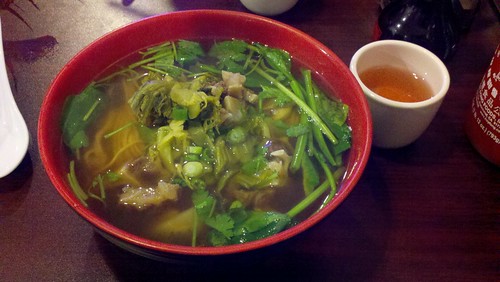
I had an opportunity to eat the most delicious hand drawn noodles with Josh Hadro, Aaron Schmidt, and Lindsay Sarin before driving back to Pittsburgh.

Noodles with ox tail