A really interesting and useful document discussed during this morning's ALA Executive Board meeting. Your feedback is welcome and appreciated.
__________________________________________
EBD #2.13
2009-2010
Midwinter 2010
TO: ALA Executive Board
RE: E-Participation Update
Architecting Participation: New Ways of Convening @ ALA
ACTION REQUESTED:
Board discussion and feedback are requested.
REQUESTED BY:
Keith Michael Fiels, Executive Director, ALA
Mary W. Ghikas, Senior Associate Executive Director, ALA
DATE: January 4, 2010
BACKGROUND:
The Final Report of the ALA Task Force on Electronic Member Participation was distributed for comment prior to the 2009 Midwinter Meeting. ALA Council acted on recommendations at the 2009 Midwinter Meeting and took additional actions at the 2009 Annual Conference. In April 2009, ALA Connect launched, offering a new set of options for member participation. More broadly, over the past several years, the extent of and variety in forms of member participation have increased, with explosive growth in blogs, wikis and social networking groups, as well as growing use of web-based meeting software. The following report (p.2-4) is a brief update on recent ALA work to broaden participation, including electronic or virtual participation.
Attached to this report is a longer, related document: Architecting Participation: New Ways of Convening @ ALA (p. 5-11). As ALA and its component groups began the work of implementing the recommendations of the TFOEMP and subsequent Council actions, numerous questions arose. These ranged from questions about the status of certain policies (see p. 5-7) to practical concerns about the impact on specific group processes (see p. 7-9) to broad strategic explorations (see p. 9-11). Architecting Participation was drafted in response and distributed to staff and to the ALA Executive Board prior to its Fall 2009 meeting.
Broadening Participation
At the ALA Midwinter Meeting in 2009, ALA Council received and acted on recommendations of the Task Force on Electronic Member Participation (TFOEMP). Recommendations of the Task Force focused both broadly on issues of expanding participation in activities of the Association and, more narrowly, on enabling broader participation, specifically including virtual or electronic participation, in those activities of the Association that have historically taken place in the face-to-face environment of the ALA Midwinter Meeting or Annual Conference.
ALA 2009 Annual Conference – 2010 Project
As an initial test of the viability of enabling widespread electronic participation in face-to-face meetings (e.g. boards or committees) at Midwinter or Annual, $40,000 in 2010 funding was allocated to support experimentation in electronic participation in conference-based meetings, at the ALA 2009 Annual Conference in Chicago.
ALA has, since 2008, routinely provided wireless access at the convention center. (From 2005-2008, ALA purchased wifi for attendees on a per-user basis.) The cost to ALA varies significantly, depending on the convention center. The robustness (stability, number of simultaneous logins) of that wireless access also varies significantly and is outside ALA’s control. Where internet access is required for successful presentation of a program (vs. a meeting), Conference Services staff continues to recommend wired access.
ALA has not in the past provided wireless access at various hotels due to availability and cost considerations. While some hotels provide free wireless, it is rarely the case with the hotels in which meetings are held. The cost to “buy out” wireless access in meeting rooms at various Chicago hotels (2009 Annual Conference) was priced from $20,000 to $160,000, depending on the number of meeting rooms and the size and structure of the hotel. Further, the number of simultaneous logins possible in any given hotel varied widely.
As it quickly became apparent that “buying out” wireless in all or most hotels where significant numbers of meetings would be held was impossible within any reasonable budget, the strategy shifted to supporting a variety of individual meetings to enable member leaders to experiment. Wireless access was provided for the following groups:
ALA President -- Unconference (Friday, Hilton)
ACRL – Leader Development & Strategic Planning (Friday, Sheraton)
Library Instruction Round Table Executive Board (Saturday, Palmer House)
ACRL Professional Development Coordinating Committee (Saturday, Sheraton)
ACRL 101 & Membership Meeting (Saturday, Sheraton)
PLA All-Committee Meeting (Sunday, Palmer House)
YALSA Advocacy Task Force (Sunday, Palmer House)
NMRT Executive Board (Monday, Palmer House)
ALCTS – CC:DA (Monday, Swisshotel)
ALCTS – MARBI (Monday, Swisshotel)
ALA Intellectual Freedom Committee (Tuesday, Hyatt)
The total cost to provide wireless access to those eleven sessions (out of 2,500 separately-scheduled events) was $30,000. The remaining $10,000 was held to support additional experimentation at the ALA 2010 Midwinter Meeting. Additionally, several groups had independently asked ALA Conference Services to provide wireless access for meetings being held outside the convention center.
Based on a wide range of discussions, both on the ground at Annual and subsequently, the following general observations can be made:
(1) Some groups, because of changes in timing or personal schedules, did not need (or use) the purchased wireless access.
(2) Wireless access was not always sufficient for the number of individuals wanting to access the network, e.g. the Unconference.
Based on AC2009 experience, Conference Services has identified some “high demand” groups or events – and will seek to schedule in the convention center.
(3) Providing wireless alone was often insufficient in large gatherings, since the person seeking to participate virtually often could not hear most of the participants, unless microphones were provided, adding (significantly) to the cost.
A small committee (<10 people) seated at a table worked successfully using Skype and a computer mic.
A larger group (>10) struggled to satisfactorily include an e-participant, who could not hear the discussion adequately to participate.
(4) Individual members and groups, including many which received no special support, were highly creative in finding ways to connect with missing members, employing a wide range of individually-provided tools.
A LITA E-Participation TF, chaired by David Lee King, compiled an extremely valuable guide to using a variety of tools. This guide is available at:
http://wikis.ala.org/lita/index.php/Participation_Task_Force_Recommendations(5) The most significant expansion in “participation” was through informal channels. Looking at post-conference statistics supplied by Jenny Levine:
There were 4,011 Flickr pictures.
A Google Blogsearch reported about 14,000 posts using the tag ala2009. (This includes the 4,011 Flickr pictures noted above.)
There were 10,362 tweets (Twitter) using the #ala2009 tag by 1,321 authors.
ALA member Heather Devine created a Flickr/Twitter tracker just prior to conference (primarily on her vacation), at
http://www.flexyourinfo.com/projects/ALA2009/ -- enabling ALA to track (and archive) this widespread participation.
There were also YouTube videos and other contributions. We do not, for instance, have a way to measure participation through Facebook.
(6) In the short run, particularly in a period where there is significant pressure not to increase registration fees, purchasing wifi for meetings in individual hotels is not a sustainable solution to the problem of expanding participation. This may change over the long term with growing market pressure on hotels and with changing technology.
ALA 2010 Midwinter Meeting
The original intent was to use the remaining dollars from the 2008-2009 2010 project to support some connectivity, specifically with groups having a strong interest in accessibility issues. David Lee King (LITA) and Mary Ghikas met with the ASCLA Accessibility Assembly during the 2009 Annual to explore possibilities. The Assembly acknowledged that there were, in fact, accessibility issues – but believed these were already identified and did not seem interested in further testing.
Based on the factors above, a different approach is being tried at the 2010 Midwinter Meeting in Boston.
(1) ALA will, as always, provide wireless access at the convention center, except for the exhibit hall. (One positive point in a difficult year: The Boston Convention Center is providing this wireless at no charge.) As usual, Conference Services advises member groups who must have uninterrupted internet access for presentations to order wired internet access. Members are also advised that the wireless access will not support bandwidth intensive uses such as streaming video.
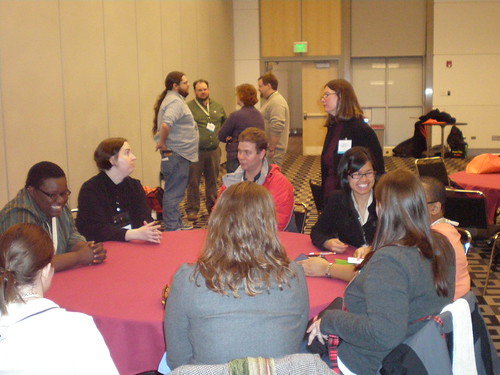
(2) ALA will set up a “Networking Uncommons” in a high-traffic area of the convention center (near the ALA Store and the entrance to the Exhibit Hall). ALA will supply round tables and chairs, an LCD projector and an av cart, a screen, electrical outlets for individuals needing to recharge laptop or PDA batteries, flip charts and markers, and some 2.0 tools (flip camera, iPod) – and the basic free wifi access. The space will be available, during the same hours as the ALA Store, for informal presentations, discussions and reports or exchanges between groups, with the potential to include virtual participants. LIS students will “staff” the space, to maintain a schedule as necessary, to ensure that equipment stays in the space, and to mediate use of tools for those who may need assistance.
Based on available funding, the intent is to provide a similar space – the “Learning Commons” – at Annual Conference, with the option of “showcasing” some projects from various groups on different days. For instance, AASL members who presented a highly successful “Blogger’s Corner” at the recent AASL National will take the lead on one day of the “Learning Commons.”
(3) In response to current member concerns around jobs, HRDR has pulled together resume review and job counseling programs. One job-related program will be presented for a “virtual” audience on Monday, January 18, 11:00am-noon. For further information, visit
http://connect.ala.org/node/90557 .
Other Steps
Discussion of expanding participation has also grown beyond the traditional face-to-face environment of the Midwinter Meeting and Annual Conference.
(1) There is widespread “experimentation” with a variety of platforms to support electronic meetings, including OPAL (ALA’s current subscription is for 100 seats, through MPS), GoToMeeting/GoToWebinar (ALCTS), DimDim (ACRL), Adobe Connect (Office for Diversity and ACRL), and WebEx (ITTS). The intent is to identify the strengths and weaknesses of each and negotiate association-wide contracts. Uses of these platforms range from open discussions to engage student members (ALSC on OPAL) to regular committee meetings.
(2) ALA Connect, which launched in April 2009, provides additional channels for expanded participation. The ALCTS Board has successfully used the chat function to “meet.” The ACRL Board has conducted votes in Connect. Members with an issue to discuss can form their own communities and move forward.
ALA Connect usage continues to grow. In December 2009, 3,162 members and 72 non-members logged in to ALA Connect. Google Analytics traffic report for October 1-December 31 shows 56,435 visits total, with 264,497 page views. Regular reports on ALA Connect are posted to the ITTS Update blog.
(3) Finally, a broader discussion is beginning around increasing participation beyond twice a year – not limited to what happens at an ALA Midwinter Meeting or Annual Conference but embracing the full range of current possibilities.
Related document attached: Architecting Participation: New Ways of Convening @ ALA, Draft4, 4 January 2010, mg.
EBD #2.13 Attachment
2009-2010
Midwinter 2010
DRAFT4 (4 January 2010)
Architecting Participation: New Ways of Convening @ ALA
Starting Points:
“To be a citizen is to show up – to accept the invitation to participate, or to create it if it is not offered, to act as a co-designer. At any moment we can choose to speak of our idealism, express our feelings, and reflect on and deepen our questions. Acting on what matters is an act of leadership; it is not dependent on the leadership of others….
…..The social architect’s task is to provide a context for the organization’s purpose or strategy, and then engage others in a way that embodies those values in people’s hearts….Social architecture is, fundamentally, a convening function, giving particular attention to all aspects of how people gather. The future is created as a collective act….Convening is a way of operating, not just a way of meeting….” [emphasis added]
Peter Block, The Answer to How is Yes: Acting on What Matters
“New ease of assembly is causing a proliferation of effects, rather than a convergence, and these effects differ by how tightly the individuals are bound to one another in the various groups. You can think of group undertakings as a kind of ladder of activities, activities that are enabled or improved by social tools. The rungs on the ladder, in order of difficulty, are sharing, cooperation, and collective action…Collective action creates shared responsibility, by tying the user’s identity to the identity of the group….”
Clay Shirky, Here Comes Everybody: The Power of Organizing Without Organizations
“Frustration is a diagnostic” Clay Shirky, speaking at American Society of Association Executives, August 2009
“It is important, as the Association moves forward, for it to be acknowledged that the demand for expanded means of electronic participation will continue to grow, and that a shift toward expanded electronic participation is inevitable. The current fiscal situation in the nation underscores the importance of continuing to explore means by which members can afford to participate in Association activities. Effective implementation of policies and means to increase electronic participation can help to attract or retain members. It can help the Association and its members to make better use of available resources. There is no holding back this tide. We must swim or be swept out by the undertow. The challenges before us include learning how to swim, deciding which stroke is appropriate to which purpose, and knowing where the shore is.” [emphasis added]
Final Report, ALA Task Force on Electronic Member Participation, January 24, 2009
Status: October 2009
• The Final Report of the ALA Task Force on Electronic Member Participation was distributed for comment prior to the January 2009 Midwinter Meeting. ALA Council acted on recommendations at the 2009 ALA Midwinter Meeting. Additional actions, on items referred, were taken at the 2009 ALA Annual Conference.
• Significant changes have been made to the policy framework for participation. ALA Council approved:
o Policy 6.17 (2009 ALA Annual Conference, on recommendation of PMC): All activities of committees, boards, etc. of the American Library Association and its units should be conducted as openly as feasible. Therefore, it shall be the policy of the American Library Association that all governance related activities, sponsored by ALA or one of its units, taking place outside of official meetings should be accessible to the membership of the sponsoring body….The policy is intended to cover all activities of committees, boards, etc. of the Association that take place between the meetings held at the Midwinter Meeting and Annual Conference and other official meetings scheduled between conferences. Activities such as discussion lists, blogs, etc., which do not meet the definition of a meeting, ALA Policy 7.4.1, are examples of activities covered by this policy….Exceptions to this Open Activity Policy are permissible for committees, boards, etc. whose discussions frequently touch on matters of privacy regarding individuals, institutions and /or organizations, or where, in the opinion of the body, its work would be hindered by open member accessibility to discussions.”
o Delete the text of newly renumbered Policy 6.18 (previous 6.16): “Policy 6.16 Virtual Members 1) Definition of Virtual Members: Virtual members of committees or task forces have the right to attend meetings, participate in debate, and make motions. Virtual members are not counted in determining the quorum nor do they have they right to vote.” (6.16 2)-4) covered appointment to Standing Committees of the Association, Committees of Council, and Round Table and Division Committees.)
o Revise Policy 4.5 (Requirements for Committee Service) as follows: “4.5.1 Membership. Except as specifically authorized, members of all ALA and unit committees, task forces, and similar bodies must be members in good standing of the group’s parent organization. 4.5.2 Participation. Members…are expected to participate in the work of the group. Participation includes both attendance at synchronous meetings scheduled in conjunction with the Midwinter Meeting or Annual Conference or at other times during the year, as well as contributions through asynchronous communication methods that may be utilized by the group outside of formal meetings. Attendance at meetings may be in person, or through other means that enable synchronous communication. 4.5.3 Provision of explanation of absences. Members ….are expected to provide explanation of their absences and/or inability to participate to the committee chair or unit secretary….” [emphasis added]
• Equally important, key policies remained unchanged, notably Policy 7.4.4 (Open Meetings): All meetings of the American Library Association are open to all members and to members of the press. Registration requirements apply. Closed meetings may be held only for the discussion of matters affecting the privacy of individuals or institutions.
o Council did (Midwinter 2009) refer to Policy Monitoring Committee a recommended new interpretation of 7.4.4, with the intent that PMC return to Council with final recommended language. Language suggested by TFOEMP was as follows: “…The primary purpose of the policy on Open Meetings is to facilitate transparency of Association governance. No member should ever feel that there are Association-related decisions made where he or she was prevented from finding information, raising concerns or expressing opinions…. Matters affecting the privacy of individuals or institutions call for a meeting or a portion of a meeting to be closed to all except members of the body holding the meeting and invited attendees…. It is the responsibility of each committee, board, etc. to insure that the spirit of the open meeting policy is enforced, to identify in advance of a meeting any need to close a portion of it, and to make that fact known in advance….It is recognized that matters may arise in the course of a meeting that necessitate closing a portion of the meeting. No matters other than those requiring protection of privacy may be discussed during a closed portion of a meeting. All actions taken in closed session must be reported to the membership of the parent unit and made public at the earliest possible time after the closed session.”
• The definition of a meeting (Policy 7.4.1) remains unchanged: “A meeting is an official assembly, for any length of time following a designated starting time, of the members of any board, committee, taskforce, commission, etc., during which the members do not separate except for a recess and in which the assembly has the capacity to formalize decisions. Conference calls, Internet chat sessions (and their equivalents), and in-person meetings are recognized as meetings subject to the open meetings policy (ALA Policy 7.4.4) (Asynchronous electronic discussions by electronic mail or other asynchronous communication methods do not constitute meetings because they are not an official assembly with a designated starting time.)
• When voting is necessary, ALA Bylaws (Article VIII, Sec. 8) authorize a variety of voting mechanisms: “Votes in the Executive Board, as well as in committees, may be taken by mail, electronic system, or conference call, provided that all members are canvassed simultaneously. An affirmative vote from two thirds of a quorum of the body shall be required. Each committee shall have the authority to set a time limit within which the votes of its members shall be recorded, but if no such time limit is set no vote shall be counted unless received within 30 days from the day the text of the matter voted upon was mailed properly addressed to those entitled to vote on the matter involved.”
• While ALA policy (ALA Bylaws, Article VIII) makes the “committee membership year” consistent with the “conference year,” policy does not, in fact, require committees to meet at conferences. Over the past decade, with the increasing availability of new communication tools, some groups (e.g. scholarship juries, many award juries) have ceased (or drastically reduced) face-to-face meetings.
Implementation Strategies and Issues: October 2009
The following issues, and strategies for addressing them, were specifically raised in discussion with ALA division executive directors and other ALA staff with significant liaison responsibilities to ALA Round Tables and ALA Standing Committees.
• Assumed commitment at time of appointment. While the change to Policy 4.5 (Requirements for Committee Service) clearly enables both face-to-face and electronic/virtual attendance at the same meeting, the work of certain groups may, in practice, require that members be physically present to participate (e.g. book/media award juries). Since “all committees are responsible to and under the direction and control of the authority that created them” [Sturgis], where the creating body believes that persons appointed to a particular committee, task force, or other similar body should commit to attend face-to-face meetings, that creating body (e.g. Division Board of Directors) may so specify in the terms of reference of the committee. The appointing officer will make appointments on the basis of those terms of reference.
o Since the ALA Council is the creating body for ALA standing committees, that would imply that a committee that believed that its work was such as to require that persons appointed to the committee commit to face-to-face participation at meetings would make their case to the ALA Committee on Organization, which would, in turn, go to Council.
o Practically speaking, creating bodies will need to act in advance of the appointment cycle.
o The range of “meeting options” is already wide – meeting face-to-face twice/year, meeting face-to-face once/year, meeting electronically/virtually only. While the dominant pattern is currently meeting face-to-face twice/year, a greater “scatter” in the pattern of practice seems likely over the next few years.
o A variety of factors will influence the “terms of reference” for a specific committee or group, such as:
The level and significance of interaction with groups likely to be meeting at face-to-face conferences. For instance, groups with a high-level of Council interaction are likely to prefer continued face-to-face meetings and to assume that members appointed will make that commitment.
The nature of the group work. While scholarship juries and most award juries have largely moved mainly or entirely to virtual/electronic meetings and work processes, the book/media award juries still rely heavily on intensive face-to-face meetings.
o Good practice would suggest that there needs to be clarity – in advance of each appointing cycle – about the needs of the group, including meeting pattern. A group that requires a high level of electronic participation throughout the year should be clear about that expectation, as should a group that requires twice/year face-to-face participation.
• Assumed commitment at time of volunteering. As appointing officers need clarity, so do volunteers require some assurance of a “match” between their level/type of commitment and the appointment they are accepting. If a particular appointment carries with it the assumption – on the part of appointing officer, committee chair and other committee members – that an individual appointed will participate in face-to-face twice/year, that assumption needs to be clear prior to appointment and acceptance. Similarly, expectation for a high level of electronic participation throughout the year should be clear in advance.
o This would suggest that some enhancement of the current “call for volunteers” system would be desirable. One possible approach, used by the American Society for Association Executives, is to provide a “matrix” for volunteering. For instance, in the ASAE example, volunteer opportunities are “banded” – opportunities requiring a commitment to attend face-to-face meetings twice/year and participate in a high level of activity between meetings; opportunities requiring a commitment to only one face-to-face meeting/year and moderate between-meeting activities; opportunities requiring ongoing (frequent) electronic/virtual participation over a regular term; or, opportunities requiring limited/short-term electronic/virtual participation. Boards and some committees fall into the “band” requiring the highest commitment level, most committees fall into the “moderate” commitment level, many other activities fall into the long-term or short-term virtual participation category. Other approaches may be developed.
o None of this suggests that a group (both staff and members) would not seek to make accommodation should a member who had made a good faith commitment prove unable to attend a face-to-face meeting. Both the ALA Executive Board and Division Boards of Directors have, from time to time, had an ill member attend key parts of a Board meeting by conference call. Boards and committees have made a variety of accommodations, ranging from conference calls to web-based conferencing systems to “indirect” electronic participation, to support participation. From an implementation perspective, however, managing exceptions is quite different that assuming that any Board or committee member may, at will, either participate face-to-face or virtually.
o There needs to be clarity about the financial responsibility for enabling “electronic participation” in face-to-face meetings. A draft ACRL “tip sheet” includes the following language: “Please note, ALA and ACRL are not responsible for any costs associated with virtual participants accessing a face-to-face meeting.” Indeed, TFOEMP made no assumption that the Association would pay the cost of having a virtual participant in a face-to-face meeting.
o Both members and staff supporting member groups have noted expressions of “resentment” within groups over perceived differences in level of commitment. This is particularly true in cases where the group values regular face-to-face meetings and where the group values a high level of electronic/virtual participation – and an individual member does not meet that expectation. While this falls within the “human nature” category, it also has the potential to disrupt effective group work and consume resources. Initial clarity as to expectations would also address this issue to some extent.
• Clarity around participation expectations, and enforcement and monitoring responsibility. The “resentment” among groups noted above is particularly acute when a member of the group simply fails to participate – and yet remains within the group. While in some cases, this is a bylaws issue, in most cases (committees, task forces) there is a mechanism for removing a non-performing member and making a new appointment. Removal of a non-performing member from a committee, task force, or similar group is rare. In many cases, chairs are unaware of the process. Orientation processes need to be clear about (a) the role of the committee chair and other leadership in encouraging performance, (b) the process to address persistent , unexcused non-performance, and (c) the revised and broadened scope of expected “participation,” including both participation in meetings (face-to-face and/or virtual) and in between-meetings activities.
o While the increased expectation of significant ongoing (between conferences) work by groups has the potential to greatly increase the volume and timeliness of Association work, both members and staff supporting boards and committees have noted some increased difficulty in keeping groups on track and motivated without the enforced focus of the Midwinter and/or Annual Conference meeting.
o Even where groups do extensive work virtually between conferences, intensive face-to-face sessions at conference are often used to orient and rally a group for the work ahead.
o Keeping work going in an electronic/virtual environment requires persistent cheerleading and support. This may require changes in (a) member leader orientation and (b) staff work assignments. It may also require some rethinking of the types of leadership that are recognized by the Association (see strategic questions, following).
• Clarity around both open meeting and open activities requirements. The open meeting policy remains unchanged – whether the meeting is face-to-face at conference, face-to-face between conferences, or virtual/electronic. The new open activities policy similarly addresses Board and committee work between meetings.
o All boards, committees, task forces and similar groups need a clear place/process for announcing meetings and agendas.
o Groups working in ALA Connect should be urged to mark a post or document “public” unless a clear reason, allowable within policy, exists to make it “private.” Note that because “private” is the default condition, this requires deliberate action.
o The open activities policy suggests that boards, committees, task forces and similar groups also need a clear place/process to announce (a) where/how between meetings activities are taking place and (b) how members may “access” those activities. By policy, “activities” must be open to members of the “sponsoring body,” so between-meeting activities of ALCTS groups, for instance, need only be made visible or announced to ALCTS members. This includes “activities” (as well as “meetings”) in ALA Connect.
Architecture, Convening and Expanding Participation: Some Broader Strategy Questions
ALA is in the process of “architecting” new processes and structures for participation. Our new architecture is composed of policy changes, new technology-based tools (e.g. ALA Connect), and new goals and objectives. It is also composed of new practices, new attitudes and new possibilities. We are challenged to create an architecture that increases member engagement, enhances member experience within the Association and within the broader library community, and supports achievement of the Association’s goals and mission.
• As Shirky notes in his book and numerous speeches, convening is, at one level, easy. “Convening” has long been a staple tool of associations – but is now accessible to almost anyone with a strong sense of mission and an internet connection. Our challenge then is to “convene” effectively, and to be clear about the value the Association adds to the “convening” process.
• TFOEMP focused on “participation” defined as membership on boards, committees, task forces and similar bodies. While that was entirely appropriate to their origin and charge, it is arguably a narrow definition of participation. ALA members also “participate” through advocacy – contacting legislators and community leaders, participating in legislative days, offering Congressional testimony. ALA members “participate” by creating and sharing content – through courses (both face-to-face and electronic), blogs, journal articles and books. ALA members “participate” by attending conferences and making themselves part of the “in the hallways” network – creating value for themselves and others.
While many members participate in all or most of these ways, some focus time, energy and talent in specific directions. Historically, ALA has tended to focus on those who participate through boards, committees, task forces and similar groups. Would a broader definition of “participation” create a more rewarding environment for members?
• Similarly, watching the dynamics of ALA Connect in its initial months, it already seems clear that members who are choosing to participate and lead by effectively starting – and maintaining – member groups in Connect are adding significant value to their community and to the Association. Maintaining a “community of practice” requires commitment, ongoing effort and a capacity to create, or elicit, content of interest to others. This same issue was noted by PLA, based on their experience with PLASpace.
We currently have no way to effectively recognize this form of leadership. Liz Lawley (University of Rochester), speaking at the October 2009 LITA Forum, noted her amazement at the impact of “points” – just “points,” not redeemable for anything. The practice of “leveling up” (using points) is familiar within the gaming community. Could we “level up” in ALA Connect – or beyond – using participation points?
• As we think about the work of “architecting participation” and “convening effectively,” can we make small changes that will enable us to more frequently be on Shirky’s top rung of the ladder: “collective action?”
Groups across the Association do good work. The question is can we make it easier to do good work important to the members of the group -- and to do work that supports the mission, goals and objectives of the Association. “Coordinating” in specific areas is currently accomplished primarily by the mechanism of the “special task force” and/or “invitational meeting.” Those aren’t bad mechanisms – and have often enabled significant accomplishments.
As we look at new tools – often technology-based – and begin looking at new goals and objectives for 2015, are there new approaches and tools for collective action across a complex association?
• After Clay Shirky’s presentation on social media at ASAE (August 2009), an unhappy association executive asked a question about how he should go about deciding to use social media. Shirky’s response was a pretty blunt – “that point passed – a long time ago.” Our members are “there,” wherever “there” is, already. Our challenge may be how to balance “control” where we absolutely must have control – and figure out how to capitalize on what’s happening where we do not – and cannot – have “control.” This may be an uncomfortable position – almost always for staff, often for members. How do we get there? What does this new way of working actually look and feel like? Is there an optimal balance between “letting go” and “controlling”?
• While ALA is continuing to expand its use of technology for virtual meetings and virtual participation, we are only beginning to explore the ways in which moving from physical to digital space both opens new opportunities for framing discussion and action and presents new challenges. Cisco recently assembled 19,000 sales people (in 89 countries and 24 time zones) virtually for its annual sales meeting, with the goals to “educate, share, interact, motivate and inspire….” The participants attended sessions, engaged in chat sessions and 13,000 participated in an alternate reality game (ARG). ALA’s context is different – with conferences that are revenue generators not net expense operations. Our technology resources are significantly thinner. The challenges – and member expectations – are just as great. What might it look like if ALA were to move closer to a “conference” in digital space?
• The pattern of face-to-face meetings at Midwinter and Annual Conference imposed a distinct rhythm to the work of the Association and its component groups. In the Council discussion of the TFOEMP recommendations (Midwinter 2009), one Councilor expressed some dismay at the prospect of a more continuous flow of Council work. How does shifting Association work into the “always on” world of the Web affect ALA work – for both staff and members? What new opportunities might it present?
• Initial discussions related to e-participation have tended to focus on the addition of e-participation to traditional face-to-face meetings. If we were to look at web-based conferencing systems and social networking platforms as additional tools for building an association community and acting on the mission of the ALA, how might we begin to make choices about which tool, including face-to-face meetings, was best suited to different purposes?
• We might reasonably hypothesize that, based on a broad definition of “participation” that included not only Council/board/committee members but others who regularly contribute to the collective good (e.g. through regular legislative advocacy), as much as 20% of the ALA membership has an “active” relationship with the Association. The short history of the Web has been of removing barriers to active participation, to content creation, to personal agency. Experience elsewhere suggests that it is reasonable to suggest that the percentage of “active” membership could be dramatically increased. What would ALA look like if 80% of members were “active” members? What would we have to do to get there?
DRAFT4, 4 January 2010, mg